

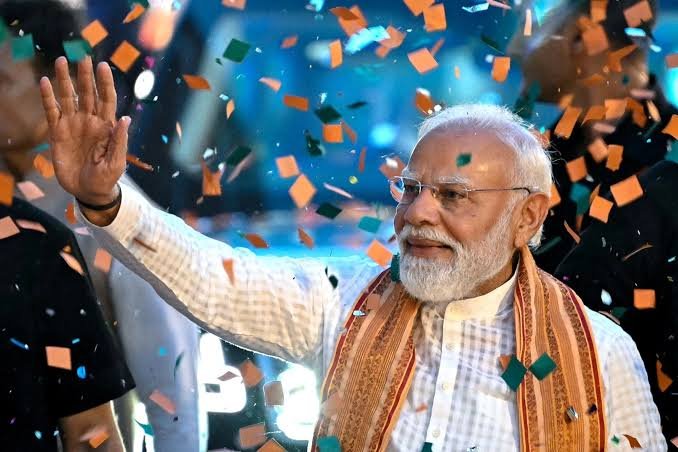
Modi - The Winning Machine
Modi going strong after 12 years while world over, governments change every 2 years
Recent assembly election results were billed as a mid-term test for Prime Minister Narendra Modi in his third term as the states that went to polls namely, West Bengal, Tamil Nadu, Kerala, Assam and the union territory of Puducherry account for a sizeable 116 seats in the 543-member strong Lok Sabha. The Bharatiya Janata Party (BJP)-led National Democratic Alliance (NDA) has retained power in Assam and Puducherry and won a landslide victory wresting power in the battleground state of West Bengal from the Trinamool Congress, well entrenched in power in the state for 15 years.
The stupendous success of the BJP in recent elections is largely due to the immense and continued popularity of Prime Minister Narendra Modi. Sample these observations from the international media which for a long time had been critical of Narendra Modi due to its own prejudices.
The New York Times (NYT) observed; “with election defeats for both Ms. Banerjee and Mr. Stalin, Mr. Modi finds himself at the helm of an India in which his opponents hold virtually no political power. Mr. Modi has made India look like a one-leader state.” The BBC concluded, “For years, India's West Bengal state was the great exception to Narendra Modi's political advance. BJP victory there would rank among the most significant breakthroughs of Modi's 12-year reign.” The Washington Post observes, “…victory in West Bengal shows that the BJP’s rise has not yet reached its ceiling.” Such assessment by global media outlets halfway into Modi’s third term mirrors his rising stature and that of India globally.
Global economic uncertainties, rising people’s aspirations and tumultuous politics are resulting in frequent changes of heads of government in all leading democracies of the world. At a time when most democracies are changing their heads of government almost every two years, Narendra Modi stands tall continuing as India’s prime minister for the third consecutive term in office. By far, Narendra Modi is the longest serving head of government among major democracies of the world today and that is a rare honour in global politics today. Contrast this with the high turnover of governments in leading democracies of the world.
Australia four and Canada three prime ministers. During this period, Germany elected three Chancellors, US three Presidents and France two Presidents. Countries in our neighbourhood have seen a major churning of governments. In the past 12 years, Nepal had six prime ministers, Sri Lanka five presidents, Pakistan (a pseudo democracy) four and Bangladesh three prime ministers.
Data from Parliaments and Governments Database (ParlGov) shows that since World War II, most countries in Europe that are parliamentary democracies got a new government every 22 months. The data further revealed that the governments in Belgium, Finland and Italy often haven’t lasted even a single year. Given the high volatility of democratic governments in the world, every time Modi meets international leaders, I guess, they would have this question on their mind as to how Modi manages to stay so popular and remain in power when they find it difficult to complete even one term in office.
Narendra Modi won back-to-back national mandates for the BJP by his nationwide appeal. What is unique about Modi is that he helped the BJP’s ride to power in several state elections on his personal popularity. This “coattail effect” of Modi in spawning victories for the BJP as the veritable party’s face in state elections is a rare phenomenon. By this ability, Narendra Modi proved to be a nemesis even in state polls for towering regional leaders like Mamata Banerjee, Sharad Pawar, Lalu Yadav, Akhilesh Yadav, Arvind Kejriwal et al.
Thanks to the ‘Modi Factor’, the BJP-led NDA that was in power only in seven states in 2014 is today in power in a whopping 22 states. The population of states under BJP rule increased from 22% in 2014 to 78 % at present. Without a doubt, the organisational muscle of the BJP and its grassroots activities are a significant factor in the BJP’s success but the massive expansion of the BJP would not have been simply possible without Modi’s leadership and personal appeal. Modi is the differentiating factor for the BJP of 2014 and the BJP at present. Love or hate Modi, but there can be no two opinions on Modi’s primary role and primacy in BJP’s nationwide expansion.
Indians tend to intrinsically trust leaders more than political parties. Narendra Modi has gained public trust with his governance track record and impeccable personal character. In a country where even ward members do everything to financially settle their kith and kin and perpetuate their families in politics, Narendra Modi comes across as a very rare exception. Modi has a large family of his own but have you ever heard that any member of his family been given any position - in the government or even party of which he is the supreme leader - or benefited from the powerful positions thatModi held? There would be none whatsoever. This emanates from Modi’s staunch belief that he has been elected to serve people and not his family. This is a rare value which few people possess and that is what makes Modi so unique and special.
Modi’s impeccable personal integrity, his hard working and uncompromising nature, his missionary zeal for India’s progress, his tough stance against terrorism, his compassion for the poor and vulnerable sections have all contributed to his leadership appeal. It is this appeal that helped the BJP to secure repeat national mandates in 2014, 2019 and 2024 elections. And, going by the recent trends, everybody including the international media, global leaders and even India’s opposition is convinced that a fourth term as prime minister for Narendra Modi is guaranteed in 2029.

GVL Narasimha Rao is a former BJP Rajya Sabha MP & a noted psephologist